Clear Intentions - Explaining The Art Of Cocktail Clarification With Neil Alexander

A well-crafted cocktail is the liquid embodiment of where art and science meet. But sometimes it’s all too easy to skew in one direction or the other and lose sight of the end goal, an issue all too common in the process of clarification. Cocktail clarification has become one of the most talked-about techniques in modern mixology. It requires an understanding of the chemistry between ingredients and the creative skill to present them in a way that captivates the audience.
To better understand its methods, purpose, and impact on flavour, we spoke with master mixologist Neil Alexander of The Good Craft Co. (TGCC) in Bengaluru, who shared his insights into how and why clarification is shaping the way drinks are crafted today.
Understanding The Basics
So, what does clarification mean in the world of mixology? At its simplest, it is the process of filtering a cocktail to make the final drink clear and free from particulates, but before the ‘what’ comes the ‘why’ of the process. As Neil explains, the decision to clarify a cocktail begins with understanding what the finished drink is intended to be. It is this vision that determines whether clarification is necessary, and it is a question that should be addressed before the process even begins.
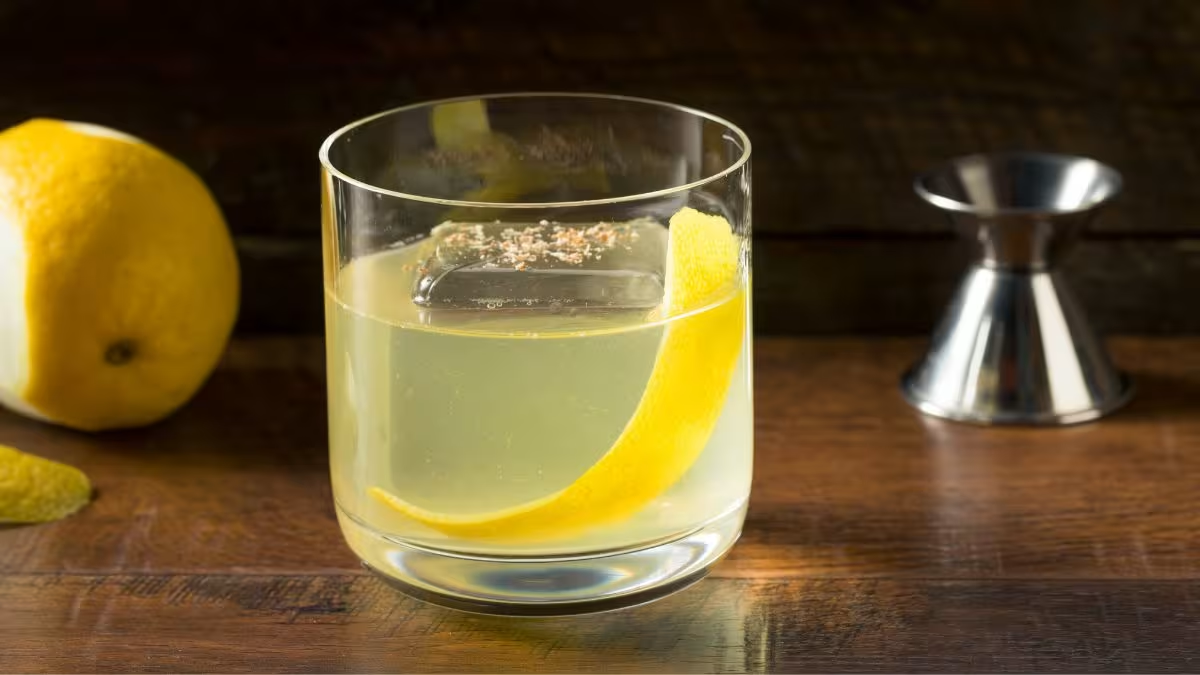
While clarification will impact the texture and brightness of cocktails, the most striking change is in its appearance. “If it looks too cloudy or murky with sediments, that’s no longer considered appealing,” explains Neil, “It used to be acceptable to serve cocktails that way, but trends have changed. Today, clear drinks with visual appeal are more popular. People are attracted to drinks that are clear but still hold flavours you wouldn’t expect. For example, guava in a cocktail usually makes it cloudy and pinkish. But if you clarify it, you can serve it looking more like a rosé wine.”
In terms of flavour, clarification is useful to temper and tame pungent ingredients for a more balanced final flavour, but not all cocktails are innately suitable for clarification. For example, Neil cites stronger flavours like garlic or curry leaf as ideal candidates, as the process dilutes the flavours and softens them. On the other hand, for milder floral flavours like jasmine or cucumber he’d suggest avoiding as it could mute their already delicate notes.
If your cocktail doesn’t meet these criteria to justify clarification, it could still benefit from it in terms of the texture. The process gives a cocktail a more viscous finish without the need for artificial methods. Beyond texture, it refines the entire composition of the cocktail. For example, he says, “If you’re using six different ingredients, after clarifying with milk you may not taste each ingredient distinctly in layers. Served unclarified, you might notice them more individually. It depends on how well the drink is balanced and how much of each ingredient is used.”
Methods Of Clarification
Putting this knowledge into practice is where precision comes into play, and each method of clarification comes with its own handbook. “You have to be careful with the ratio you use,” says Neil, “I stick to different recipes depending on the ingredients. Filtration is another form of clarification. You can do it over a fine mesh strainer with a cheesecloth, with a coffee siphon and filter paper using a V60, or through cold conditioning. Cold conditioning is when you let a pre-batched cocktail rest for a week or so, allowing sediments to settle at the bottom, and then you siphon filter it.”

Milk Clarification
At The Good Craft Co., milk clarification is the most commonly used method. As Neil puts it, “It’s the simplest and easiest method, and when you clarify any cocktail with milk, it alters the entire flavour profile of the cocktail.” Using whole milk or dairy alternatives relies on the natural fats and casein to bind impurities in the cocktail. He adds that milk washing is very simple if you approach it logically, but there’s no hard and fast rule or ratio as you have to be flexible enough to adapt around each cocktail’s different composition. The idea is to first build the drink, decide on the flavour profile you want, highlight any particular ingredient, and then balance it by calculating the citrus content.
With Indian spirits, there is also the opportunity to experiment with dairy notes that complement traditional ingredients. Saffron, cardamom, rosewater, kewra, sandalwood, tulsi, kokum, and tamarind are all well suited to this method, as they can withstand or even benefit from light clarification. Aromatic oils are preserved without muddying the colour, and combinations such as cardamom and rosewater pair beautifully, gaining subtle creamy notes in the process. The key is to use small percentages to keep balance with spice and herbal elements, ideally testing with a neutral spirit such as gin or vodka before applying the method to more complex bases.
Agar Clarification
Using gellan or agar, this method forms a clear gel-like matrix that traps solids, producing exceptional clarity while allowing vibrant botanicals to come through. In Neil’s creations, he prefers to pair it with Indian ingredients that showcase freshness and brightness, such as gondhoraj lime, grapefruit, kokum, moringa, and hibiscus. Agar clarification is especially effective in cocktails built around fruit-forward components such as mango or tamarind, or syrups infused with saffron, where the technique preserves both the vibrancy and the aromatic depth of the ingredients.
Fat Washing
Fat washing involves dissolving fats into a spirit, then freezing the mixture so the solids can be separated. The result is a spirit with a rich, rounded texture and lingering nutty or buttery notes. Indian flavours lend themselves naturally to this process. Coconut oil, buttered puffed rice, peanut oil, almond, mustard oil, ghee, sesame oil, chai-spice blends, bay leaves, and dried chillies all bring unique character when used for fat washing. Coconut oil or peanut oil, for instance, can add tropical warmth to gin or whisky while enhancing vanilla, almond, or spice elements already present in the spirit.
Indian Ingredients And Clarification
Mixology in India has recently begun moving away from conventions set abroad and instead are drawing on the country’s own rich cultural and culinary heritage. Through initiatives like TGCC, indigenous ingredients are coming to the forefront, with their vast potential increasingly recognised in the cocktail space. Clarification, in particular, is opening new avenues for learning and experimentation.
“Not all indigenous or local ingredients go through clarification, but they are used in different formats,” explains Neil. “Many are used raw, while others are incorporated through lacto-ferments, bitters, tinctures, infusions, or syrups.” One such experiment involves Dukshiri, a rare root from Goa introduced to Neil by Hansel Vaz. “It’s very hard to find. Dukshiri belongs to the same family as Nenari (Vetiver) and even liquorice root, but sourcing the variety used in traditional preparations is almost impossible. That’s a new ingredient I’ve been working with.”
Spices remain another cornerstone of his approach, with long pepper, tephal, nutmeg, mace, and stone flower among those regularly explored. Fruits, abundant in India, are generally familiar rather than exotic. To bring out new dimensions, Neil often turns to fermentation, using fruit to create intriguing bases for cocktails.
The Philosophy Of Clarification
While clarified cocktails have undoubtedly become fashionable, Neil points out that the technique can sometimes need to come back to purpose and the original question of why should a particular drink be clarified in the first place? “I’ve been doing milk washing and clarification for a long time in Bangalore, well before it became trendy,” he reflects. “It only really gained popularity more recently, influenced by Japanese and other Asian bartenders who emphasise crystal-clear drinks.”
Yet clarity shouldn’t always be the goal. A Piña Colada, Neil notes, should be creamy and opaque. To strip it of that changes its very identity. Likewise, entire menus of clarified drinks feel excessive to him. Some cocktails, he insists, are meant to be enjoyed exactly as they are. His approach is ultimately one of restraint and intention. “I’m always careful to ask myself why I want to clarify a drink. If there’s no valid reason, I won’t do it. And in bars where drinks are served in copper, steel, porcelain, or clay vessels, clarification isn’t needed at all.”
In the end, clarification remains a powerful tool, but one best used with purpose and the intent to serve the drink in its most elevated form, rather than overshadowing it.

Drink Responsibly. This communication is for audiences above the age of 25.
Shireen Jamooji

More from The Bar




Stay Inspired
Sign up to our newsletter for exclusive recipes, insider secrets and special offers - all delivered straight to your inbox.
